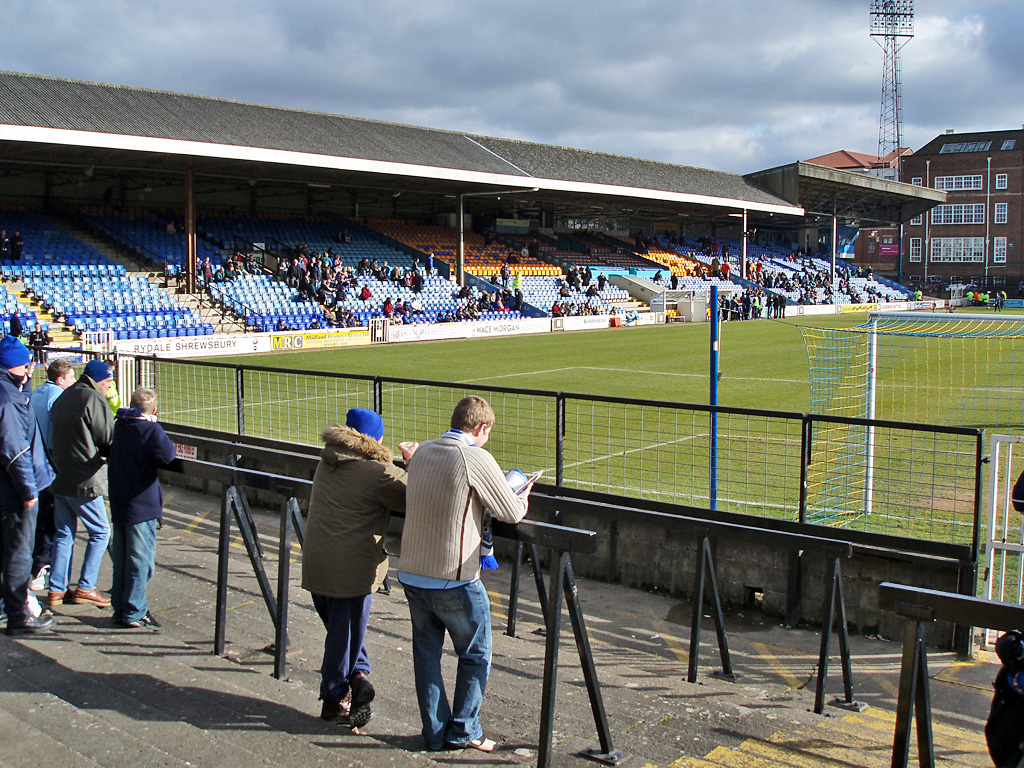
Gay Meadow
1910-2007
Historical Overview
Gay Meadow was a football ground in Shrewsbury, Shropshire, England, serving as the home ground of Shrewsbury Town. Located on the banks of the River Severn, it opened in 1910. The ground closed at the end of the 2006-07 Football League season and the club moved to a new stadium, provisionally titled The New Meadow, on the outskirts of the town. Local legend says that over 22,000 were inside the stadium for the league match against Wrexham on 21 August 1950, although the official figure is given as 16,000. The official record attendance is 18,917, set on 26 April 1961 against local rivals Walsall. Because it had only one entrance and exit road, in the years following the Taylor Report the capacity of the ground was reduced from 16,000 to around 8,000. Centuries before Shrewsbury Town occupied the site, Gay Meadow was known locally for the fairs, carnivals and circuses which took place there. The origin of the name is not entirely clear, although it is widely believed to be related to a use for entertainment purposes. One suggestion by local historian J.L. Hobbs is that it is of Norman influence and that the ground was a monastic park attached to Shrewsbury Abbey. Other suggested origins are the Welsh word Cae, a field, or Old English words galla, barren wet land, or gat, a goat. An alternative origin states that the land was originally owned by the Gay family, first represented by a Richard Gegh of Monks Foriet, later Abbey Foregate, recorded in 1349. In 1739, stuntman Robert Cadman, a steeple-flyer, attempted to fly across the River Severn using a rope attached to St Mary's Church at one side and a tree at Gay Meadow some 200 feet below. Tragically for Cadman, the rope broke and he plunged to his death. In 1910, Shrewsbury Town were looking for a new ground to play at, having been told they could no longer use the Army-owned pitch at Copthorne Barracks. A consortium bought the site and leased it to the club. Despite objections from the local hospital, the Salop Infirmary, who feared crowd noise might disturb patients across the River Severn, the first official match took place on 20 August 1910, when a crowd of up to 1,000 watched a pre-season practice match between the Reds and the Whites. The first league game at Gay Meadow was between Shrewsbury Town and Wolverhampton Wanderers Reserves on 10 September 1910. Shrewsbury lost the match 2-1. The ground did not see major improvements until the mid-1950s, when trees which lined The Narrows, the road leading to Gay Meadow, were felled to improve access. It was around this time that the club's supporters launched a floodlight committee in order to raise 12,000 pounds for the installation of floodlights. On 25 November 1960, a crowd of 5,448 saw Shrewsbury Town beat Stoke City 5-0 in a match to mark the installation of the lights. The floodlights formed part of the Shrewsbury skyline for almost 47 years. New offices were built at the ground in 1965, with the Riverside terrace being built in the early 1970s. This terrace would gain legendary status amongst home fans in years to come. In the early 1980s, the club's promotion to the Second Division meant the ground required further improvements. The old 600-seater Station Stand was demolished and a new 4,500 capacity centre stand built. This was the last major building work to take place at the ground before its closure. Gay Meadow was located on the banks of the River Severn and was surrounded by trees and parkland, with the town centre towering above the ground on the hilltop behind. A number of the town's landmarks, including Shrewsbury Castle and Shrewsbury Abbey, were visible from the ground. For many years, Shrewsbury coracle maker Fred Davies would sit in his coracle during home matches and retrieve stray footballs from the river. Although Davies died long ago, his legend is still associated with the club.
Did You Know
Gay Meadow was a football ground in Shrewsbury, Shropshire, England, serving as the home ground of Shrewsbury Town. Located on the banks of the River Severn, it opened in 1910. The ground closed at the end of the 2006-07 Football League season and the club moved to a new stadium, provisionally titled The New Meadow, on the outskirts of the town. Local legend says that over 22,000 were inside the stadium for the league match against Wrexham on 21 August 1950, although the official figure is given as 16,000. The official record attendance is 18,917, set on 26 April 1961 against local rivals Walsall. Because it had only one entrance and exit road, in the years following the Taylor Report the capacity of the ground was reduced from 16,000 to around 8,000. Centuries before Shrewsbury Town occupied the site, Gay Meadow was known locally for the fairs, carnivals and circuses which took place there. The origin of the name is not entirely clear, although it is widely believed to be related to a use for entertainment purposes. One suggestion by local historian J.L. Hobbs is that it is of Norman influence and that the ground was a monastic park attached to Shrewsbury Abbey. Other suggested origins are the Welsh word Cae, a field, or Old English words galla, barren wet land, or gat, a goat. An alternative origin states that the land was originally owned by the Gay family, first represented by a Richard Gegh of Monks Foriet, later Abbey Foregate, recorded in 1349. In 1739, stuntman Robert Cadman, a steeple-flyer, attempted to fly across the River Severn using a rope attached to St Mary's Church at one side and a tree at Gay Meadow some 200 feet below. Tragically for Cadman, the rope broke and he plunged to his death. In 1910, Shrewsbury Town were looking for a new ground to play at, having been told they could no longer use the Army-owned pitch at Copthorne Barracks. A consortium bought the site and leased it to the club. Despite objections from the local hospital, the Salop Infirmary, who feared crowd noise might disturb patients across the River Severn, the first official match took place on 20 August 1910, when a crowd of up to 1,000 watched a pre-season practice match between the Reds and the Whites. The first league game at Gay Meadow was between Shrewsbury Town and Wolverhampton Wanderers Reserves on 10 September 1910. Shrewsbury lost the match 2-1. The ground did not see major improvements until the mid-1950s, when trees which lined The Narrows, the road leading to Gay Meadow, were felled to improve access. It was around this time that the club's supporters launched a floodlight committee in order to raise 12,000 pounds for the installation of floodlights. On 25 November 1960, a crowd of 5,448 saw Shrewsbury Town beat Stoke City 5-0 in a match to mark the installation of the lights. The floodlights formed part of the Shrewsbury skyline for almost 47 years. New offices were built at the ground in 1965, with the Riverside terrace being built in the early 1970s. This terrace would gain legendary status amongst home fans in years to come. In the early 1980s, the club's promotion to the Second Division meant the ground required further improvements. The old 600-seater Station Stand was demolished and a new 4,500 capacity centre stand built. This was the last major building work to take place at the ground before its closure. Gay Meadow was located on the banks of the River Severn and was surrounded by trees and parkland, with the town centre towering above the ground on the hilltop behind. A number of the town's landmarks, including Shrewsbury Castle and Shrewsbury Abbey, were visible from the ground. For many years, Shrewsbury coracle maker Fred Davies would sit in his coracle during home matches and retrieve stray footballs from the river. Although Davies died long ago, his legend is still associated with the club.
What Happened
This venue was demolished and no longer exists on this site.

